|
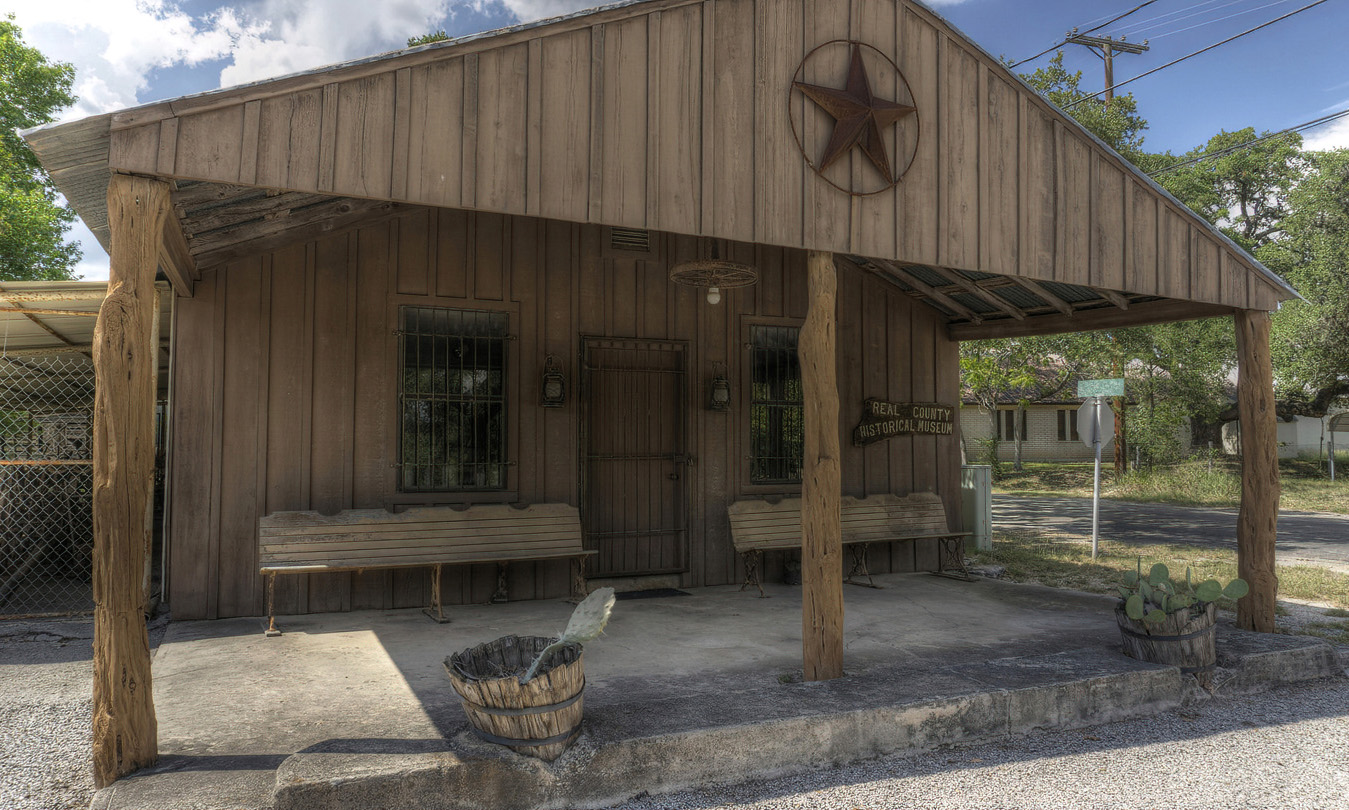
Real County Historical Museum County Information
Leakey, Texas
REAL COUNTY. Real County (M-13) is in southwest Texas, bounded on the north
and west by Edwards County, on the east by Kerr and Bandera counties,
and on the south by Uvalde County. The center of the county lies
at 29°50' north latitude and 99°50' west longitude,
100 miles northwest of San Antonio. The area was named for Julius
Real,qv the only Republican in
the Texas Senate when the county was formed in 1913. Real County
encompasses 622 square miles of the Balcones Escarpmentqv on the southern edge of the Edwards Plateau;qv its terrain is characterized by sharply dissected canyonlands
crossed by numerous streams, which flow from perennial springs
in the water-bearing strata of the Edwards and Glen Rose limestone
formations and descend the escarpment over beds of limestone,
gravel, and calcareous soils. Headwaters of both the Frio and
the Nueces rivers lie within Real County; the Nueces forms the
county's western boundary with Edwards County. Elevations range
from 1,500 feet in the valleys to 2,400 feet in the northern part
of the county at the edge of the plateau; the mountains and ridges
in the western half of the county, the eastern edge of the Nueces
Canyon, are steeper and more rugged than those along the Frio
Canyon to the east. Rainfall averages 23.88 inches annually. Temperatures
range from an average low of 35° F in January to an average
high of 96° F in July; the growing season lasts about 235
days. Although agriculture has been of limited significance to
the area since the earliest periods of human occupation, arable
land is found in the valleys, where pecan trees are plentiful.
It is believed that until the middle of the nineteenth century
forestation in the area was confined to the bottoms, while the
uplands were covered with rich grasslands, which, coupled with
the abundance of water, ensured a constant supply of game animals,
birds, and fish as well as berries, nuts, and roots. Today the
area is heavily forested with live oak, Ashe juniper, and mesquite
on the ridges and uplands as well as on the hills and escarpment.
In the early 1980s much of Real County's economy revolved around
ranching. In 1982, 83 percent of the county's land was in farms
and ranches; about 2 percent of the land was irrigated, and 97
percent of the county's agricultural receipts derived from livestock,
especially cattle, sheep, and angora goats. Only about 3 percent
of the county's workforce was engaged in manufactures; tourism
supported 117 workers, more than any other industry in the area.
Archaeological excavations in the region reveal Paleo-American
occupation contemporaneous with the presence of now-extinct fauna.
There have been numerous archaeological finds of materials from
the Edwards Plateau and Central Texas aspects (the two most extensive
known prehistorical culture complexes in Texas), which represent
Archaic and Neo-American stages, respectively. The beginning of
the Edwards Plateau aspect is dated around 5,000 B.C. Occupation
sites, along stream terraces and limestone promontories or in
caves and rock shelters, are extremely numerous throughout Real
County; they are almost invariably marked by burnt-rock middens,
the massive accumulations of cracked and discarded limestone hearthstones,
and other cultural debris, which are a definitive feature of the
Edwards Plateau aspect. Sometimes erroneously called "mounds,"
the middens reach several feet in thickness and sometimes extend
over an acre, revealing generations or even centuries of habitation
at individual sites. The people who occupied these sites had an
economy based on hunting (primarily deer), and though it is virtually
certain that no agriculture was practiced, there is evidence that
vegetal products were of some importance to the inhabitants. Although
the larger sites suggest a sedentary culture, the absence of agriculture
indicates that small bands in the area probably roved in search
of game and plants, returning periodically to a central location.
The Neo-American stage began around A.D. 600. Occupation sites
are situated similarly to those of the earlier Archaic period,
but accumulations of cultural debris are far less extensive; these
later inhabitants may have practiced some agriculture, and pottery,
much of it tradeware, is common at the site. By the beginning
of the historical period Tonkawas, probably the descendants of
this indigenous population, inhabited most of Central Texas, including
Real County. By the first decades of the eighteenth century Lipan
Apaches had gained control of the Upper Nueces Valley. In 1762
El Gran Cabezón, a powerful Lipan band chief seeking protection
from the Comanches and their allies to the north, persuaded Franciscans
and elements of the Spanish military to establish San Lorenzo
de la Santa Cruz Mission on the Nueces River near the site of
present Camp Wood. Later, a second mission, Nuestra Señora
de la Candelaria, was established downriver at the site of Montell
in present Uvalde County. The Lipans, nomadic bison hunters, did
not adjust to mission living, however, and the establishments
were never officially sanctioned or given adequate support by
Spain's colonial government. The Lipan bands that had settled
there had departed by 1767, and San Lorenzo was finally abandoned
in 1771. Numerous specimens of rock art in Central Texas have
been discovered in the canyons along the headwaters of the Nueces
and Frio rivers. While the origins of these paintings are unclear
(some of them can definitely be dated to historical times), they
were probably produced by the Tonkawas and their Neo-American
ancestors, then added to by their Lipan and Comanche successors.
The paintings constitute the eastern periphery of rock art in
the state.
The character of Anglo-American settlement in the
area was largely determined by geography. The most prominent features
within the county are the Frio and Nueces river canyons and the
steep divide between them. To a great extent, settlement of these
canyons proceeded separately. Anglo settlers arrived in the Frio
Canyon in 1856 when John and Nancy Leakey, along with several
others, settled near the town that now bears their name. Sometime
between 1856 and 1860 a settlement was also established downriver
at Rio Frio. In 1867 Theophilus Watkinsqv arrived there, and the following year he began to construct a
gravity flow irrigation canal that operated for a century. Anglo
settlement in the Nueces Canyon began during the same period.
In the spring of 1857 the United States military post of Camp
Wood was established on the Nueces River near the site of the
former San Lorenzo mission. The post was abandoned in 1861, when
federal troops were withdrawn from Texas at the start of the Civil
Warqv and was subsequently occupied
by Confederate forces; following the war it was periodically used by
Texas Rangersqv and the United
States Army. Edward D. Westfallqv moved to Camp Wood during the 1860s, as did Jerusha Sanchez, who
later served as a midwife in the Nueces Canyon. The Hill family
were other early settlers in the area. In the 1870s Henry Wells
and others established Bullhead, a settlement later renamed Vance,
at a site on the Nueces to the north of Camp Wood. Hostile encounters
with Indians, primarily Lipans who still passed through the isolated
region, were relatively common during the early period of Anglo
settlement, and as late as the 1980s residents still recalled
hearing first-hand accounts of such incidents. Particularly well-known
were the stories of the Schwander, Coalson, and McLauren families.
In 1864 Lipans attacked the family of George Schwander, who was
living in the abandoned ruins of the San Lorenzo mission, during
his absence, killing his wife and abducting their son, Albert,
who a year later was ransomed from Mexico. In 1879 at Half Moon
Prairie, also in the Nueces Canyon, Indians attacked and killed
Jennie Coalson, wife of Nic Coalson, and two children. In 1881,
in the last Indian raid in Southwest Texas, Lipans struck the
McLauren home at Buzzard's Roost in the Frio Canyon while John
McLauren was away, killing his wife, Kate McLauren, and teenaged
Alan Lease, a neighbor who was living with the family.
In 1883 Edwards County, which included part of the
area of present-day Real County, was organized. Bullhead served
as the Edwards county seat from September of that year until 1884,
when voters moved the seat to Leakey. The government of Edwards
County remained at Leakey until April of 1891, when it was moved
to Rocksprings after a disputed election. After Rocksprings was
declared winner of the election, the results were contested by
residents of Leakey (who themselves were accused of ballot-box
stuffing). Judge Hunter, a local magistrate, organized a group
of men, crossed the divide, and moved the county records from
Leakey to Rocksprings during the night. Social activities in the
late nineteenth and early twentieth century included house parties,
picnics and barbecues, baseball games, and religious services.
Though ranching has always dominated the local economy, crop farming
was of some importance until the early twentieth century. In the
late nineteenth century cotton, corn, oats, tobacco, and wheat
were grown in the Frio Canyon. Also in Frio Canyon lumber was
produced from indigenous cypress trees, which were cut and processed
at water-powered mills. Freighting products and materials in and
out of the canyons was another important early economic activity.
After 1910, however, crop farming declined in the area, partly
because of a boll weevilqv infestation, and ranching emerged as the predominant enterprise.
The raising and breeding of angora goats for mohair became particularly
important to the local economy; by the early 1910s, when Real
County was established, there were more angora goats in the area
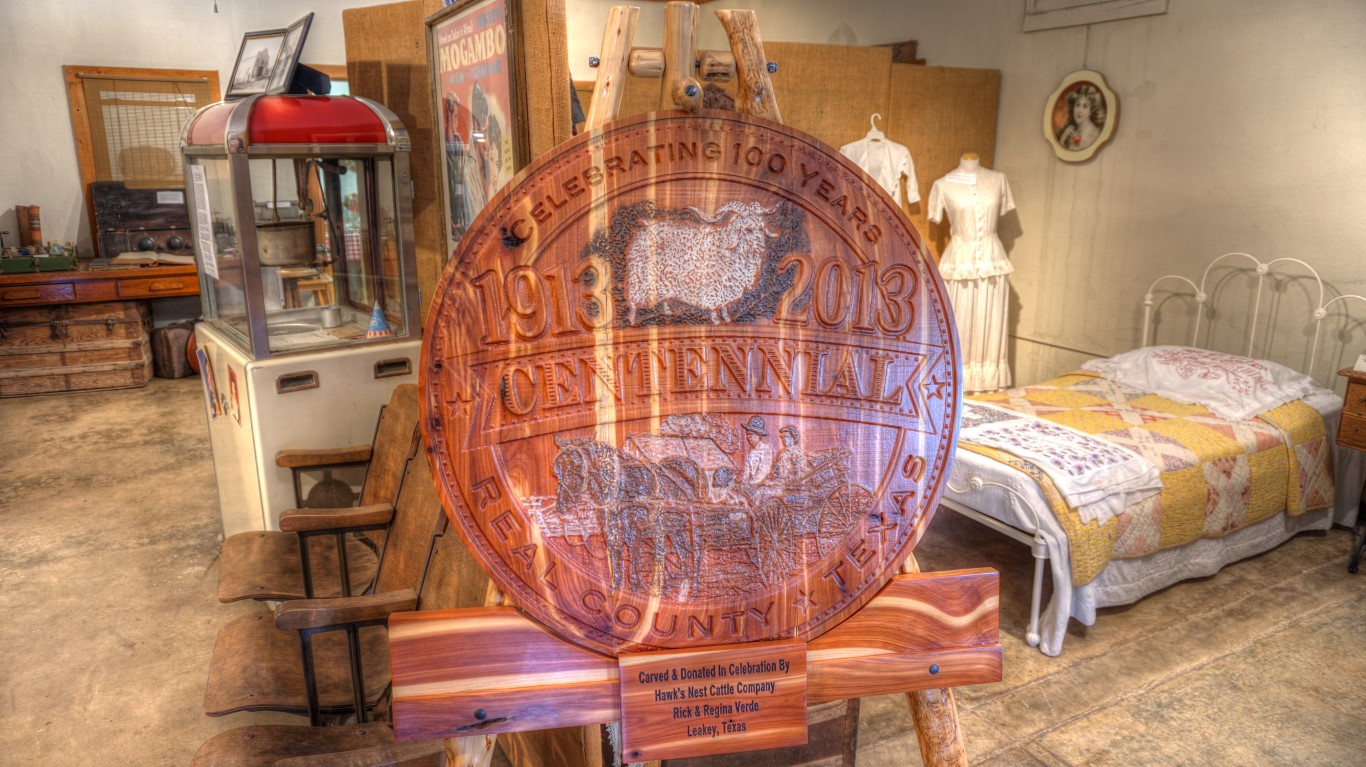
than in any other county in Texas. In the spring of 1913 the Texas
state legislature established Real County from parts of Edwards,
Bandera, and Kerr counties. The action was prompted by the isolation
of the area and the difficulties residents experienced traveling
long distances over bad roads to Rocksprings or Bandera (the seats
of Edwards and Bandera counties, respectively) to conduct business.
Leakey was elected county seat. In 1920 the United States Census
counted 1,461 people living in Real County; 260 farms and ranches,
encompassing 360,000 acres, had been established in the area by
that time. The economy of the county centered on ranching. Over
103,000 goats, 18,300 sheep, and 6,000 cattle were reported in
Real County that year, while only 2,800 acres were devoted to
corn and 1,200 acres to sorghum, the county's most important crops;
another 174 acres were planted in cotton.
The settlement of Camp Wood, occupied since the 1850s,
was formally founded as a town in 1920, when it became the northern
terminus of the Uvalde and Northern Railway built by the Uvalde
Cedar Company. The town and the railroad were established as part
of an effort to harvest and transport heart cedar (to be used
mainly for fence posts and telephone poles), and in hopes of exploiting
a deposit of a rare type of kaolin clay found in the county. Though
the railroad was closed in 1942, after the area's cedar resources
were exhausted, for a time the project helped to tie the area
to national markets and encouraged immigration into the area;
by 1925 there were 317 farms and ranches in the county, and by
1930 the population had increased to 2,197. Ranching, especially
the raising of sheep and angora goats, continued at the center
of the local economy. The agricultural census for 1920 reported
6,777 cattle, 18,326 sheep, and 103,075 goats in the area. In
1930 there were 2,862 cattle, 39,550 sheep, and almost 137,000
goats in the area; over 580,000 pounds of mohair were produced
in the county that year. Though local farmers planted some wheat,
cotton, corn, and sorghum, crop farming did not really take hold
in the area; in 1930 only 6,000 acres in the county were devoted
to crops. Cropland harvested in the area declined slightly during
the Great Depressionqv of the
1930s, but the number of farms and ranches in the county rose to
300 by 1940. The county's population also rose to 2,420 by 1940.
Angora goats remained an important part of the local
economy but the number of goats steadily declined after the mid-1950s,
when there were more registered angora goats in Real County than
any other county in the United States. Thereafter the number of
goats in the county dropped to 90,000 in 1959, to 60,000 in 1960,
and to 18,000 in 1982. While ranching continues to dominate the
local economy, some of the abundant local crop of pecans is marketed,
and in recent years tourism and hunting have assumed increasing
importance for the county. In the latter half of the twentieth
century a great deal of local real estate has been purchased by
outsiders, who use the land for vacation homes and hunting; at
the same time, large numbers of young people have left the area
in search of greater opportunities. After reaching 2,470 in 1940,
the county's population declined to 2,079 by 1960 and to 2,013
by 1970. The number of people in the area rose during the 1970s,
however, reaching 2,469 by 1980. In 1990 there were 2,412 people
living in Real County. The voters of Real County supported the
Democratic candidates in virtually every election between 1916
and 1952; the only exceptions occurred in 1924, when they supported
Republican Calvin Coolidge, and in 1928, when most of the county's
vote went to Republican Herbert Hoover. In elections between 1952
and 1992, however, the county's voters swung to the Republicans
in every election but two: in 1964 most Real County voters backed
Lyndon B. Johnson,qv and in 1976
the county supported Jimmy Carter.
Prior to 1948, when Farm Road 337 was completed,
most travel between Camp Wood and Leakey was accomplished by way
of Uvalde on the Nueces River to the south, a trip of ninety miles;
as a result, people living in the county's two canyons developed
different identifications and loyalties. In the 1980s people in
Real County were still inclined to differentiate between themselves
on the basis of residence in one or the other canyon rather than
identifying with one another as residents of a common county:
the canyons, rather than the county, serve as the primary basis
for group identity and organization. Though the propertied population
of Real County has been overwhelmingly of European descent, the
labor of Mexican-American tenants and Mexican migrants has been
essential to the local economy; almost 24 percent of the county's
population is of Mexican descent. Retail establishments, fraternal
lodges, and VFW halls have continued to function as centers of
social life in the county. There are a number of legends concerning
lost or abandoned mines and buried treasure in the area. Some
evidence indicates that a smelter once operated at the San Lorenzo
Mission, and John Bell Hood,qv who prior to the Civil War commanded the military outpost at Camp
Wood, reported signs of silver extraction (presumably by Spaniards),
at the "Pepper Mine," a shaft to the south of Meridian
Mountain in the western part of the county. A. J. Sowell identified
an abandoned shaft and stone fortification on the divide separating
the Main and Dry branches of the Frio as the site of James (Jim)
Bowie'sqv 1831 prospecting endeavors,
though this is far from certain. Following the Civil War John R.
Baylorqv moved into the Nueces
Canyon, drawn by reports of gold; one of his sources may have been
Henry Castro, who is said to have examined accounts of the smelter
at San Lorenzo in Mexico City. Baylor was unsuccessful in his search
for mineral wealth. Though county residents generally seem skeptical
regarding stories of buried treasure, they will confirm the persistence
of the treasure hunters (some equipped with way bills or maps) who have
combed the area for rumored Spanish or ill-gotten hoards. Communities in
the county include Leakey (1990 population: 399), the seat of government;
Camp Wood (595); and Rio Frio (50). Leakey hosts a July Jubilee
in the summer.
BIBLIOGRAPHY: Beverly Ann Chiodo, "Real County," Southwestern Historical Quarterly 65 (January 1962). J.
Frank Dobie, Coronado's Children: Tales of Lost Mines and Buried
Treasures of the Southwest (New York: Garden City, 1930).
Thomas Hester, Digging into South Texas Prehistory: A Guide
for Amateur Archaeologists (San Antonio: Corona Press, 1980).
Grace Lorene Lewis, A History of Real County (M.A. thesis, University
of Texas, 1956). Allan A. Stovall, Nueces Headwater Country:
A Regional History (San Antonio: Naylor, 1959).
John Minton
Article taken from  |